
The Commission for the Control of INTERPOL's Files in practice
What the Commission for the Control of INTERPOL's Files does, the difference between an access request and a deletion request, and what to include.
The only standard way to file a request with INTERPOL’s Commission for the Control of Files (CCF) is online. That's it. This secure portal is your legal gateway to access, correct, or delete personal data they hold—often the first move in fighting a Red Notice. While you used to be able to use email or post, as of 26 March 2026, the online portal is now mandatory for all requests.
What is the Quickest Way to File a Request with INTERPOL's CCF?
Forget paper forms and old email addresses. The only standard method for filing with the Commission for the Control of INTERPOL's Files (CCF) is through their secure online Portal. This rule applies to every type of request: access, correction, and deletion. The entire system was centralized to tighten security and speed up processing.
As of 26 March 2026, at 10:00 CET, that portal became the one and only channel for new submissions. This means if you try to use the CCF's old email or mail a paper form, your request will almost certainly be rejected. The only exception is under "exceptional circumstances," a high bar defined by Rule 25(2) of the CCF Operating Rules, which might apply if, for example, a person is incarcerated without internet access.
Why file a CCF request at all? It's how you exercise a fundamental legal right. You can find out if INTERPOL has a file on you, see what's in it, and demand correction or deletion if the information is wrong, outdated, or violates INTERPOL’s own rules. Think of it as an essential data protection check inside the massive global policing organization.
What Exactly is the CCF and What is its Legal Authority?
The CCF is an independent, impartial body. Its job is to ensure all personal data flowing through the INTERPOL Information System follows the organization's own regulations. It is, in effect, INTERPOL's internal data protection watchdog, a check on the information shared between police forces in its 196 member countries.
Its power comes directly from INTERPOL’s Constitution and is spelled out in the Statute of the Commission for the Control of INTERPOL’s Files. Specifically, Articles 18 to 21 of the Statute give the CCF the authority to handle requests from people like you seeking to access, correct, or delete their data.

To do its work, the CCF is split into two chambers. The Supervisory and Advisory Chamber watches over the big-picture application of INTERPOL's data rules. But the body you'll deal with is the Requests Chamber. It formally decides on individual applications and its decisions are binding—the INTERPOL General Secretariat must comply.
What is CCF INTERPOL?
Put simply, the CCF (Commission for the Control of INTERPOL's Files) is the official data protection tribunal inside INTERPOL. It’s a neutral body allowing individuals to find, challenge, and seek removal of their information from INTERPOL's databases. This includes data that underpins alerts like a Red Notice. It acts as an independent check to make sure INTERPOL’s own rules, including those related to human rights, are being followed.
How Do I Find Out If I Am on an INTERPOL List?
There's only one official way to know for sure if you're on an INTERPOL list: file a "Request for Access" with the CCF. This is the mandatory first step. You can't ask for data to be changed or deleted until you've formally asked to see it.
Here’s how the process breaks down:
- Create an Account on the CCF Portal. You or your lawyer must register on the secure portal. There's no way around it.
- Gather Your Documents. You will need a clear, complete copy of an official identity document like a passport. It must show your full name, date of birth, and photo. A common mistake here is submitting a redacted or poor-quality scan, which will get your application flagged as inadmissible and delay the whole process. If a lawyer is filing for you, they'll also need a Power of Attorney you've signed.
- Submit the Access Request. Fill out the online "Request for Access" form. This part is straightforward. You don't need to write a lengthy legal argument; you just need to state that you're requesting all data held on you in INTERPOL's files.
Once your request is declared admissible, the clock starts. According to the CCF's Statute, the Commission has four months to give you a decision. So, if your request is accepted in February, you should expect an answer by June at the latest.
How to get an INTERPOL background check
INTERPOL does not offer "background checks" for civilian use, such as for a job or an immigration application. The only way for you to check INTERPOL's files for your own data is to submit a formal "Request for Access" via the CCF. This is a personal data protection right, not a commercial service.
What is the INTERPOL Report Form?
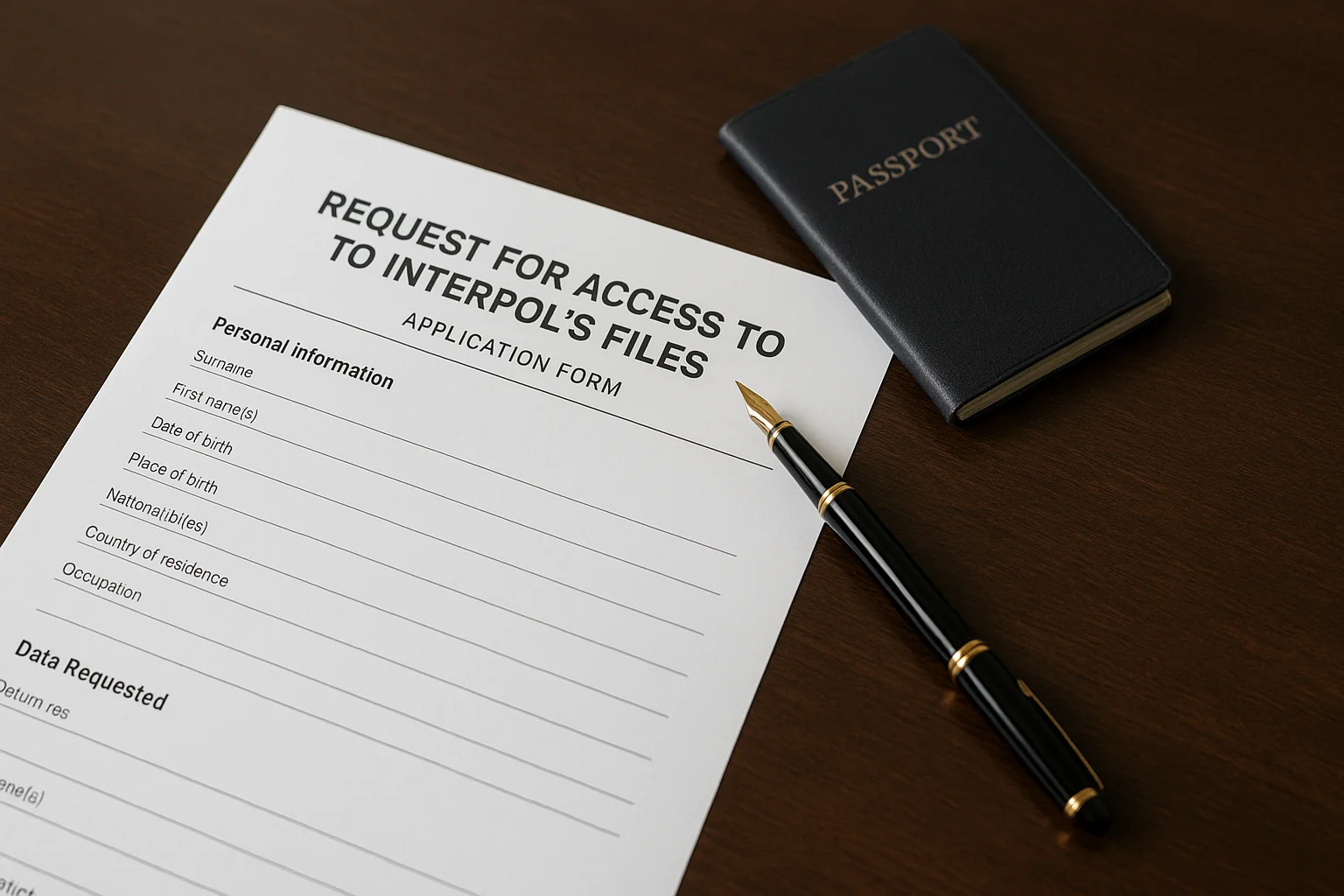
The "INTERPOL Report Form" was the old PDF application you had to fill out for postal or email submissions. While you might find old versions of this form online, they are now obsolete for filing. All new applications must go through the online CCF Portal, which essentially walks you through a digital version of the same questions.
What are the Main Grounds for Challenging an INTERPOL Notice?
To get an INTERPOL notice removed, you must file a "Request for Correction or Deletion." Your argument must be laser-focused on how INTERPOL has violated its own rules—simply claiming you're innocent of the original crime is not enough.
Successful challenges are often built on these grounds:
- The notice is political, military, religious, or racial. INTERPOL's own constitution, specifically Article 3, forbids it from undertaking any activities of this character.
- There is no valid legal basis. The domestic arrest warrant that the notice is based on might have been cancelled, expired, or was flawed from the very beginning.
- The data is inaccurate or outdated. The information in the notice is just plain wrong, missing critical context, or no longer relevant to the case.
- The action is disproportionate. A Red Notice is for serious crimes. Under Article 82 of the Rules on the Processing of Data, the offense should generally be punishable by at least two years in prison. A notice for a minor offense may be challenged as disproportionate.
- It violates human rights. You can argue there is a clear risk you would face a flagrant denial of justice, torture, or other inhuman treatment if you were arrested and extradited based on the notice.
How Do I Challenge and Remove an INTERPOL Notice?
If your access request confirms INTERPOL has a file on you—or if you already know a notice exists—your next step is filing a "Request for Correction or Deletion." This is a far more complex legal battle than a simple access request.
- Build your legal case. You have to submit a detailed factual summary (capped at 10 pages) backed by solid evidence. This could be anything from court orders cancelling a warrant, proof of your refugee status, or expert reports showing the political nature of your prosecution.
- Submit through the CCF Portal. Use the same account you created earlier, but this time select the option for correction or deletion. You'll upload your legal arguments, factual summary, and all supporting documents. Vague arguments will fail; the CCF requires precise legal reasoning, which is why most people hire a lawyer for this stage.
- Wait for the decision. This part requires patience. A lot of it. The CCF has up to nine months to review the case and make its findings. Before a final decision is rendered, the INTERPOL General Secretariat gets one month to comment on the CCF's preliminary conclusions, which can sometimes influence the final outcome.
Remember, these timelines only begin once the CCF declares your request "admissible," meaning you’ve correctly submitted all the required forms and documents.

| Request Type | Purpose | Key Requirement | Official Timeline (from admissibility) |
|---|---|---|---|
| Request for Access | To find out if INTERPOL holds data about you. | Proof of identity. | 4 months |
| Request for Correction/Deletion | To challenge and remove a notice. | Legal arguments and supporting evidence. | 9 months |
Where Can I Find Official Contact Information and Resources?
For the most reliable and direct information, go to INTERPOL's official website and find the section for the Commission for the Control of Files (CCF). That page will have the link to the secure portal where all requests must be made.
A critical point many miss: the INTERPOL General Secretariat (which coordinates police work) is completely separate from the CCF (the data protection body). You must direct any questions about your personal file exclusively to the CCF through its portal. Contacting the wrong department is a common mistake that leads nowhere.
How to contact INTERPOL
For any personal data issues—access, correction, or deletion—you are required to use the secure CCF Portal. No public email address or phone number exists for filing or checking on a case. For general, non-case inquiries, you can use the public contact form on the main INTERPOL website. For country-specific issues, contact that nation's INTERPOL National Central Bureau (NCB).
How to report cyber crime to INTERPOL
INTERPOL is not a police force that takes crime reports from the public. If you are a victim of cyber crime, your first and only step is to report it to your local or national police. If they determine the crime crosses international borders, they are the ones who will decide whether to engage INTERPOL's channels for cooperation with police in other countries.
⚠️ Time is critical — every day matters
Get a free case assessment
Our team specialises in cases with an international element. We review applicable treaties, assess risks, and prepare an action plan.
This article is published by an independent law firm for informational purposes only and does not represent or claim affiliation with any government body, international organization, or official authority.
FAQ
How long does a CCF request take?
Often several months to more than a year, depending on the complexity of the case.
What is the difference between access and deletion?
An access request confirms whether data is held; a deletion request seeks its removal or correction.
Do I need a lawyer to file a CCF request?
You can file it yourself, but the request is technical and evidence-heavy, so specialist help is common.
What can I include in a deletion request?
Reasoned arguments and evidence that the data breaches INTERPOL's rules, such as a political character or inaccuracy.